The Kruskal-Katona theorem characterizes the face vectors of simplicial complexes. More precisely, given the number of faces of dimension k-1, the theorem gives an upper bound on how many faces of dimension k a complex could have. Conversely, if an integer vector satisfies these bounds for all values of k, then it is the face vector of some simplicial complex, so the bounds of the Kruskal-Katona theorem are sharp.
A simplicial complex is called a flag complex if all minimal non-faces are two element sets. Flag complexes are the same thing as clique complexes of graphs. Since flag complexes are simplicial complexes, the bounds of the Kruskal-Katona theorem apply to flag complexes. However, they are not sharp for flag complexes. For example, a simplicial complex with 9 two-dimensional faces can have up to 3 three-dimensional faces. A flag complex with 9 two-dimensional faces can have no more than 2 three-dimensional faces.
We obtain better bounds on the face numbers of flag complexes than the bounds of the Kruskal-Katona theorem. Given the number of faces of some particular dimension, there is some largest dimensional face that the complex could have. For example, a complex with 30 edges could have a face of dimension 6, as a six-dimensional simplex would use only 28 of the edges. It cannot have a seven-dimensional face, as that alone would require 36 edges.
If a simplicial complex does not have as large of a face as is possible, then we use bounds from a previous paper. We show that these bounds are strictly less than the bounds of the Kruskal-Katona theorem, although they are not sharp.
If the simplicial complex does have as large of a face as possible, the bounds of the previous paragraph usually coincide with those of the Kruskal-Katona theorem. Instead, we derive new bounds for this case, which only apply when the complex has as large of a face as is possible. We then show that the new bounds are almost always much better than those of the Kruskal-Katona theorem, though these bounds are not sharp, either.
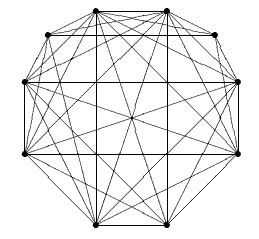
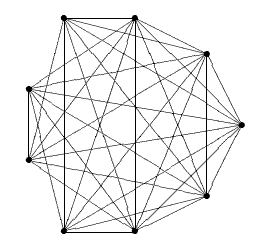
Finally, we use the results to show that bounds on consecutive face numbers are not enough to characterize the face vectors of flag complexes. A flag complex with 70 2-dimensional faces can have at most 85 3-dimensional faces. This bound is sharp, as shown by the following graph.