INFINITY and
the IMAGINATIOIN
POESIS
“Infinity is a fathomless gulf into which all things vanish.” Marcus Aurelius. 121-180. Roman Emperor and Philosopher
“Infinity
is where things happen which can’t.”
Young student quoted by Arthur Koestler in the Act of Creation.
“Infinity is a dark illimitable ocean without
bound.” Milton. 1608-1674.
English Poet
An
infinite set is one that can be put into one to one correspondence with a
subset of itself. George Cantor 1845-1918.
German Mathematician.
“Infinity
converts the possible into the inevitable.”
Norman Cousins. April
15. 1978
The
universe is not bounded in any direction.
If it were, it would necessarily have a limit somewhere. But clearly a thing cannot have a limit
unless there is something outside to limit it. Lucretius. 99-55
BC
Who
can number the sand of the sea, and the drops of rain, and the days of
eternity? Ecclesiastes 1:2
“Oh
moment, one and infinite!” Robert
Browning. Poet 1812-1889
To
see a world in a grain of sand
And
a heaven in a wild flower,
Hold
infinity in the palm of your hand
And
eternity in an hour. William Blake. Poet, artist. 1757-1827
It
was a dark and stormy night Images.…
We
must not take the One as infinite in extent, but rather as infinite in fathomless
depths of power. Plotinus . 3rd century mystical
philosopher. Ennead 6.9.6
The
One cannot be measured: it is the measure, not the measured. Ennead 5.5.11
Nothing
bothers me more than the possible infinity of space and time. Yet, nothing bothers me less, as I never
think about them. Anonymous joke.
LONGER REFERENCES:
Archimedes: The Sand Reconer
Dedekind:
on the irrational
Hwa
Yen: Fa Tsang’s hall of mirrors
A.
ANCIENT QUESTIONS
COSMOLOGY SPACE AND INFINITY
From
ancient times people asked: how did the universe begin? Where did it come from? They looked up into the night sky, wondered
at the multitude of stars, and about what was beyond the stars. Did the universe go on forever, or did it
end? They pondered the composition of our Earth and physical world: were there
some minute particles which made up the world?
And as they thought about the universe, and imagined about its source
and endlessness, they wondered also about themselves-- the unlimited nature of
their own imaginations, and their thoughts.
If
you imagine traveling through space toward the supposed boundary of the
universe, what would you expect to find?
It is mind boggling to imagine that the universe is endless, actually
infinite. And it is inconceivable to
suddenly meet with a boundary to the universe.
If there is a boundary to the universe, what is beyond the
boundary? Since the universe is
“everything”, there can’t be anything beyond it. So why is there a limit or boundary? Is beyond the boundary the emptiness of the Void, absolute
nothing, or the pure freedom of God?
These themselves are good candidates for infinites. And if there is no boundary, and the
universe goes on forever, infinitely, this is beyond imagination. ? Either conclusion: that the universe is
somehow limited, or that it is actually infinite, are frightening, or
impossible, or paradoxical.
Questions
about our own world, planet Earth, gave people some ideas about the
universe. If you went very far, you
came to the oceans. What is beyond the
ocean? Although somewhere along the
line European culture forgot that the earth is round, and Columbus had to
recall this fact to us in 1492, the Greek Eratosthenes measured the
circumference of the earth before 300 BC to a great degree of accuracy. This is a remarkable feat. First of all, he had to know it was round,
without going around it, and secondly he used some clever geometry to estimate
its circumference.
If you look at a ship leaving at sea, and the water is very calm, and the Earth is flat, you should see the whole ship receding into the distance. But as the earth is round, you see the bottom of the ship disappear and the mast sticking up from the horizon longer.

Eratosthenes started at a point A
on earth where the sun was directly overhead at noon. The next year, he observed the sun on the same day from a town B
some 400 miles north. Using basic
geometry, and supposing about the sun’s rays are parallel, we find that the
angle the sun deviates from direct overhead is equal to the central angle which
the arc AB subtends (see picture).
A simple ratio gives us that
6/360 = 400/Circumference. With these
numbers, we get Circumference = 24000.
When
one looks at the sky during the day, the sun seems to be moving, and the stars
seem to move across the sky during the night.
It looks as if there is a huge sphere carrying the heavens along. If the universe is rotating, and there is
no “empty space”, then what is the shape of the universe? If we consider a bug which lives on just on
a circle, then the bug can go only forward or backward. As it moves forward, it encounters no
boundary, but it is in a finite universe.
Similarly,
if we are in a spherical universe, then we can go on forever without hitting a
boundary. At some point we sees ahead a
very familiar sight: the earth from which we originated. We have come back to the origin, although we
traveled in a “straight” path, a “geodesic.”
It will be important to say more about this idea of “straight” since it
is intrinsically bound up with the question about the shape of space.
We
may also use dreams to see how the universe can be contained and yet
unlimited. If you wake up in a dream ,
or find yourself in a dream, you do not know how or when it began. You were not there. And the you in the dream experiences trees,
a world, of the imagination. If you
begin traveling, the dream world is as vast as your imagination. Although the universe of the dream is not
“there” in an objective sense before you explore it, as you do explore you find
it has no boundary. Moreover, when you
wake you find that the entire dream was “in” your imagination, even the dream
starts, trees and so on. Whereas the
dream contents were, at any moment, finite, the imagination or mind of the
dreamer was not. And from the
perspective of the person really having the dream, it took place within a
finite time. An entire sequence of
years of events in the dream leading up to the alarm ringing in the dream was
precipitated by the beginning of the alarm ringing, perhaps 30 seconds of
wakeful time.
Several
possible ways to think about the universal space/time can be imagined:
Unbounded and infinite, unending,
eternal.
Bounded and finite.
Bounded but infinite, in the sense of an
infinite number of infinitesimal parts or particles. Unbounded but finite, like
traveling in a circle.
Exploration 1
1. a.
What does infinity mean to you?
Write or draw pictures about two meanings of infinity.
- Is there
anything in your experience which is infinite? Explain or give a description.
2.
In what sense are each of these finite/infinite:
1/3
The
border of Cayuga lake.
A
circle.
The
graph of y = x3 .
The
universe
Your
mind.
3. a.
An ancient debate about the divisiblity of matter led to speculation
about the nature of atoms. If you
imagine dividing a line segment in half, then in half again and so on, what
happens "eventually"? Think about the question in terms of your
imagination and also in terms of a piece of paper that you keep cutting in
half. What kind of a geometric object
will you get if you imagine continuing to cut a line segment in half
indefinitely?
b.
A related problem in the number realm concerns .9. Many people think (believe) that .9 = .999... is not equal to 1 and some forms of
("non-standard” analysis allow .9 ≠ 1. However most mathematics books say that .9 = 1. Which seems most reasonable to you? .9 = 1 or .9 ≠ 1? What are the most convincing arguments for
your answer? Make as explicit as you
can what assumptions you are making and why you accept these assumptions as
true.
4. How would YOU answer the argument in Zeno’s
Achilles and the Tortoise dilemma? What
happens when a thought process or thought model like Zeno gave seems to not fit
the physical world? What are the assumptions
being made to say Achilles does not reach the tortoise?
5. How many pieces of paper would you need to
pile up to make a pile as high as the Moon?
If
you fold a piece of paper in half, and then in half again you get 2,4,8, …
pieces of paper thick. How many times
would you need to FOLD a piece of paper to get a pile as high as the Moon?
(You
can consider that the moon is 400,000 km from Earth)
6. How many earths would fit into a sphere the
size of the sun?
How
many earths would fit into a sphere with diameter equal to the diameter of the
Earth’s orbit around the Sun?
If
you make a scale model of the solar system and you make the sun 1 meter in
diameter, how far is the Sun from the Earth?
(You
can consider that the Sun diameter is 100 times the Earth, and the Sun distance
to the Earth is about 100 times the sun
diameter. The moon diameter is about ¼
of the earth, and the moon distance to Earth is about 100 times its diameter.)
If
an atom was as big as the earth, how big would the earth be? (You may consider that an atom is on the
scale of 10–10 meters in diameter.
INFINITY in a cultural context
The
Greek word aiperon , which we usually
translate as “infinite” means disordered, chaos, indefinite, indeterminate, and
also was slang for a crumpled piece of stuff.
It was not a positive meaning.
For
Aristotle in 5th century BC, “being infinite is a privation, not a
perfection but the absence of limit.”
Aristotle also had a “fear” of the Void, of a vacuum, of the conception
that there would be anywhere which was really and totally empty. Questions about space and time being
infinite or unending, can be asked in terms of the number system. Are the whole numbers infinite? In what sense? Aristotle skirted the issue
by saying that the integers were potentially infinite, but not actually so, as
at any point you could only count finite.
He was quite a pragmatist.
Plato,
however, says that “God exhibited the limit and the unlimited.” So he takes it that unlimitedness is a
divine quality.
In
the Vedas, much more than 3000 years old, the sages state that Brahman is the
full (purna), and whatever the Absolute Brahman manifests does not affect
Brahman, for taking the full from the full leaves the full. You can see how this can be represented
mathematically: taking all the odd numbers from the numbers leaves an infinite
number of numbers. And in the Rig veda:
“Whence is this universe and who created it? The Gods are later than this world’s production, and so cannot
say its origin. The one who lives in
highest heaven, who alone precedes the universe, alone knows about its
origin. Or perhaps, that one also knows
not.”
Another
key notion here is Measure. For Hindu
philosophy, for example, the universe is “measured out” from the Infinite. The name for the principle of manifesting, Maya, means measure. In the Timeaus of Plato, the Infinite
divinity--the Demiurge-- measures out the World Soul and the manifest
universe. This is all accomplished
through the word for ratio: logos. The
world soul inserts ratios into the living stuff of its own being in order to
manifest space and time. And “in the
beginning was the word, and the word was with God…” the word for Word is also
Logos. So is some view the universe is
finited out of the infinite.
Although
the universe may be finite, that which gives rise to the universe need not
be. Attributes of The One of Plotinus,
the Brahman of the Upanisads, the Tao, are infinity, timelessness,
omnipresence. And for other traditions, the absolute is empty, sunya, Void. We will see how the Infinite and the Zero
are intimately connected.
Chuang
Tsu presents the idea of the “absolute necessity of what has no use” in a short
story with that title. At any given
time you stand on one square meter of earth.
But take away the rest of the Earth you are not standing on right now,
and you will face a terrifying void, rendering the square meter you are on
right now useless. Thus, Chuang points
out, is the absolute necessity of what has no use.
In
one sense, all of our finite math depends on the infinite, on there being no
end to the system of numbers. So we are
actually safe using as large number as we like. It is like saying that the images in the dream in any given dream
are finite, but the mind which dreams is not limited or bounded by the
particular dreams.
If
our own mind and imagination can think about these questions, does that mean
that we are infinite? By the principle
of reflection, does that mean that the infinite actually exists?
UNCOUNTABLY LARGE:
ARCHIMEDES SAND RECONER
Questions
about the universe being endless can be made more precise in terms of the
counting numbers. There seems to be no
last counting number (if there were, just add 1 to it), yet we cannot easily
grasp the entirety of the counting numbers.
If you start with 2 and double, double, (no trouble) what will
happen? Is there any numerical end to
the doubling? You should also think about this geometrically: repeatedly
scaling a picture by 2. Even imagining
very large numbers is difficult for the imagination. Can you really picture a million dots? A million anything? Many
early cultures had names for 1,2,3 and
then just said “many.” Any number beyond their counting system was therefore
large, or uncountably finite. Many
people, up to 5th century BC, thought that the number of grains of
sand were infinite.
The
great 3rd century BC mathematician Archimedes, in his little work
“the sand reconer” gives a remarkable sequence of stages of scale: grains of sand in a grain of rice, grains of
rice in a foot, feet in a mile, miles in the earth (known through Erotosthenes)
and even the distance to the Sun.
Archimedes fills the whole known universe with Sand and still calculates
a finite, but very large, number.
Maybe it is on the order of 10100. But it is finite. In the
Vedas there is made use of a number 10140 . This is larger than the number of atoms in
the known universe. So in what sense is
it actual?
TIME
Similar
questions apply to time as well. See
four views of time in ancient philosophyFor Plato, time was a moving image of
eternity. Later on, especially in the
1st-10th centuries, mystical philosophy also thought more deeply
about the nature of Reality and the infinite.
Fa Tsang hall of mirrors.
Tibetan Buddhism. Plotinus and
Proclus. Eckhart. For Plotinus, time was the motion of the
(divine) soul. For Augustine (?), the God was
sphere whose circumference was nowhere, and center everywhere. See my four views of time: as psychological, cosmological, geometric,
and cyclic.
PROBLEMS:
7.
How long ago is 1 million, 1 billion, 1 trillion years?
8.
A king gives as a prize a grain of rice
on the first day, and double that for every day in a month. How many grains of rice is that after 30
days? Would that much rice fill the classroom?
The Earth?
9. Are
the counting numbers actually infinite?
They don’t end. But each number
you can name is finite. Are the even
numbers infinite? They also don’t end.
But the even numbers is a subset of the counting numbers. Aren’t there fewer even numbers? This leads to a paradox about infinite sets
.
CAUSALITY AND INFINITE REGRESS
Causality
also presented a problem. If this
moment is caused by a previous one M2, then that must have its cause in the
previous M3 and so on. This is called
an infinite regress. [There is a famous
story about a person at a lecture:
turtles all the way down.]
Heraclitus,
in 5th century BC, said you cannot enter the same stream twice, as
each moment the entire universe has changed.
In fact, you cannot even enter the stream once.
VERY SMALL: THE
INFINITESIMAL Matter
If
one looks at the very small, one is also led to the infinite. Is there a
smallest particle? What is the
constitution of the universe? The search for a smallest particle, or for the
ultimate constituent of universe, for the nature of motion, leads either to the
exploration of infinitesimals, or to divisibility to 0.
Democritus
argued that there are smallest particles, atoms. But can not these atoms be divided further?
Whenever
you have a small interval, such as 0 to 1, you can divide it in half. You
can keep doing this. Does this
imply that there are an infinite number of decreasing intervals? What happens eventually?
Archimedes
helped make this physical question quite precise mathematically, using the
concept of measure. He felt that there
was no particle which has measure 0.
Acceptance of his “Axiom” about
measuring segments is at the heart of
2000 years of exploration which followed Archimedes.
Axiom
of Archimedes:
No
matter how small a particle P, and no matter how large a measuring unit U, we
can always find a counting number N so that multiplying the length of P by N
will be larger than U.
For
example, if a particle is only 1/1014 meters in length (about the
size of a nucleus of an atom), then simply multiply by 1015 (or line
up that many atoms in a row) to get longer than a meter.
Does anything have 0 measure? Is there some infinitesimally small particle, which results from dividing a line in half, in half again, and so on forever? If there is, it cannot satisfy the Axiom of Archimedes. Because if an infinitesimal blip has length 0, then multiplying it by any integer, no matter how large, will give 0: by the axiom that 0 x N is 0, for all whole numbers N. So you must give up that Archimedes axiom, or you must give up that 0 x N must be 0.
ZENO’S
PARADOXES
Zeno
(5th century BC) gave famous examples to show the paradox of motion,
also based on the problem of the infinitely small. Achilles goes faster than the Tortoise, but cannot catch her,
because first he must get half way to her, then 3/4 of the way, then 7/8 and so
on. An arrow cannot really move in
getting from A to B. Because at any moment we see it the arrow
cannot move to the next instant. If it
did, it would have to move halfway, and half of that etc. And you cannot leave this room. For the same reason.
[Let’s
stop here to appreciate what the problems are.
Draw pictures. Etc.]
Do
these processes actually yield infinity or infinitesimals, or only ‘potentially”
infinite numbers or sets, as Aristotle thought, or is this only a semantic
distinction, as Cantor, the 19th century mathematician who went far
to solve some of the problems, thought?
B. INFINITY and
PROCESS in GREEK MATHEMATICS 6th
– 4th c. BC
Although
the Greeks did not seem to like the infinite, they encountered several
situations where the infinite was either absolutely necessary, or at least was
very useful. Before Pythagoras, the Greeks thought, or perhaps they thought,
that all of mathematics could be encompassed by the finite, or at least by
whole number ratios. Everything was
ratio. But Pythagoras, Eudoxus, Euclid,
Archimedes, Applonius--the greatest mathematicians of the golden age of Greece
in 6th to 4th century BC—actually considered the
infinite, grappled with the problems through mathematical explorations. They circumvented the inability to grasp
the infinite in the large or small directly, in one gulp, by attempts to grasp
it through potentially infinite processes or repeated activities of getting
larger and larger or smaller and smaller.
Through their work in the realm of mathematics, they helped to make
sense of practical problems, as well as helping us to think more clearly about
philosophic ideas of infinity.
We
will explore some of the following major developments about infinity from the 6th-4th
c. BC:
A prime number is a number which has only
itself and 1 as divisors. Are the
number of primes finite or unending?
How could one prove a set is infinite, without counting all
examples? Euclid gave a proof about the
infinity of the number of primes in the 5th century BC. And
Eratosthenes gave a method called a “sieve” to find all prime numbers.
A straight line seems like a
straightforward finite object. But: can
a line can be extended indefinitely?
Euclid’s definition of a straight line assumed it could.
What is the relation of the diagonal of a
square to its side? Can you find a
measuring unit small enough so that it will exactly measure the diagonal and
side a whole number of times? Can you
express the relation of side to diagonal as a whole number fraction? Pythagoras explored this question in the 6th
century BC and found a dismaying answer which invoked the infinite.
How to you find the area of a circle, or
other curved regions, in terms of square units? What is the value of pi, the ratio of circumference and diameter
of a circle? Archimedes answered these
questions in the 4th century BC, through using a potentially
infinite process.
Theorem of Euclid: The area of any
triangle with a given base and height is the same.
So:
What if we allow the base to stay fixed at one unit, and move the third vertex
way far away along a line parallel to the base. How can the area stay fixed?
THE
IRRATIONAL/INCOMMENSURABILITY
We
can try to fill in or name all the points on the line with ratios of whole
numbers, which can be constructed individually or all at once by a remarkable
method using the number lattice. It can
be shown that between every two rational numbers there is another. This is called the property of being
dense. But this means that if r is a
rational number, there is no “next” rational number.
PROBLEM 11: Show how to find a rational number between
any two given rational numbers r and s.
Pythagoras,
in the 6th century BC, understood that there are numbers, or
relations, which are very finitely and easily constructible, such as the
diagonal and side of a square, but which cannot be represented by whole number
ratios. Another way to say this is that if there is a square with side length 1
unit, the diagonal cannot be
represented as any finite ratio of two whole numbers. Its length does not fall on any of the rational number points on
the number line. So there are numbers
which are NOT the ratio of any two whole numbers. Pythagoras and his group kept this idea secret for some time. The
existence of so- called “irrational” numbers was as a tremendous blow to
finitist views held by some of the mathematicians of the time. .
Let
us explore this problems a little further.
It can be shown that the diagonal of a square d with side 1 is such that
d2 is 2. In other words, d
is the side of a square with area 2.
You can then try to express d as a ratio of two numbers m and n. By a proof by contradiction, or by
exhaustion, or by self-similarity, you will see that it is impossible. Thus the length d does not correspond to any
point on the number line with rational name, even though these points are
dense. And even though, in fact, one
can write down a sequence of rational number which get as close as one likes to
d. In fact, one can write as many
elements as one likes of a set, all of whose members is less than d, but for
which d is the smallest number not in the set.
Thus, although d names a point on the line not hit by a ratio of whole
numbers, we can approximate d as closely as we like by a sequence of rational
numbers. This fact lead Dedekind, 2000
years later, to formulate a careful and precise definition of irrational
numbers as limits of sets of rational numbers.
Embedded
in proofs of the incommensurability of the side and diagonal of a square is the
notion of self-similarity: if something is self similar (that is, identical to
a magnified piece of itself) then that thing must be infinite. (see the pictures here, land of lakes,
mirrors and so on.) Self-similarity is
crucial for an understanding of the infinite in a mathematical sense
PROBLEMS
12.
How do you know that every whole number
division either ends or repeats? For
example, 1/5 = .2 But .3 = .333…
13.
What does it mean that there is no rational number corresponding to
√2? Do the divide and average
algorithm for √2. Show that the
sequence of numbers gets closer to √2.
14 What happens when you take √ over and
over? Try starting with at least three
different numbers, using your calculator.
Note how long it takes.
15
Large and small perimeter problems. An attempt to measure a two dimensional
region using length results in infinite measure. An attempt to measure one dimensional length as area, results in
0. Explain this giving your own
examples and pictures.
16
To get a potentially infinite perimeter
with finite area, imagine iterating the process of dividing a paper in half and
adding it on to itself to get larger and larger perimeter. Show that the perimeter can be made greater
than any given whole number of units.
17
How do you find the area of a curvy
figure such as a circle, using square units?
Come up with at least two ways of your own, before reading the method of
Archimedes.
18
Explain what Pi is. Explain Archimedes’ itertive process by which he could (potentially)
estimate pi to any desired accuracy.
WHOLE
NUMBER LATTICE AND COUNTING.
We
can get a picture of this relation of rationals and irrationals in another
way. Consider the whole number lattice:
points on the plane with coordinates whole numbers. We can correlate each fraction m/n to a point in the number
lattice (n,m) and the slope of the line joining the origin and the point (n,m)
is m/n as well.
PROBLEM
19: Draw a line through the
origin and a point (n,m) in the lattice.
a.
Prove that the line must go through an
infinite number of points in the lattice.
b.
Prove that, any other point (p,q) in the
lattice that is on the line has the same fraction value n/m.
c.
Prove that if you look from the origin
down a line which goes through some point in the lattice, the point seen first
represents the ratio of slope of the line in lowest terms, say 2/3, and all the
other points have coordinates which reduce to the ratio 2/3.
20. Draw line L vertically at x=1. Prove that a line OM through the origin and
any point M(n,m) will intersect L at the point
(1,m/n). Thus we can
construct all fraction lengths along the line L.
21. Can there be any lines through the origin which do not pass through any of the other points on the whole number lattice? If so, how would you describe one? If not, why not?
COUNTING
THINGS
If
you want to count things, you can list them.
By doing this you are essentially putting down one thing for each
successive counting number. So you are
making a 1-1 correspondence between counting numbers and your set under
investigation. We can use the 1-1
principle to tell if two sets have the same number of elements, even without
counting them! For example, if I have a
large number of shoes in the closet, I can know if the number of left and right
are the same even without knowing how many of each there are. So we can compare the magnitude or number of
sets by putting their elements into this 1=1 correspondence. What happens when we do this with infinite
sets? For example, Gallileo showed
that every square number can be corresponded to the whole number it is the
square of, and so the whole numbers and squares are just as numerous.
1 2 3 4 5 6 7 8 9 …
1 4 9 16 25 36 49 64 81 …
So
we have put a 1-1 correspondence between a set and one of its subsets. George Cantor used this property as his
definition of infinite: a set is infinite if it can be put into 1-1
correspondence with a subset of itself.
He then went on to show that there are an infinite number of different
orders of infinity, as we shall see But not every whole number is a
square.
Hilbert,
19th- 20th century mathematician, ran a famous
hotel. It had an infinite number of
rooms numbered 1,2,3,… When a busload
of 40 people came to visit, even though the rooms were all full, he had no
problem He moved each guest into a room
with number 40 higher than they started, leaving the first 40 rooms empty for
the new guests. Then a busload with an
infinite number of guests wearing numbers 1,2,3,… came to town. He moved each of the already present guests
to a room which had an odd number: double plus one the number they started
with. He had each of the new guests
move into an even number room which was
double the number on their t shirt.
This left room 1 for himself.
THE
WHOLE NUMBERS ARE JUST AS NUMEROUS AS THE RATIONAL NUMBERS
There
is a Systematic way to list or name all of the rational numbers. It “proves” that the number of rational
numbers or fractions is the same as the number of whole numbers.
List
all fractions whose num. and den. sum to, successively, 1,2,3,4,5,…N... Within each group order the fractions by
numerator from 0 to N-1.
So
the Rational numbers are, in order, 0/1, 0/2, 1/1, 0/3, 1/2, 2/1, 0/4, 1/3,
2/2, 3/1,…
Can
we do this with the irrational numbers?
How do we describe all the numbers which fill in the “gaps” in the
rationals? Can we fill in the gaps? Can points ever fill in a line, which has
dimension? It was George Cantor in the 19th century who formulated
clearly the view that the set of all the irrational numbers could NOT be put in
1-1 correspondence with the whole numbers: there was no way to make a list of
all the irrationals as you could do with the rationals. And there was not only the infinity of the
whole numbers, but there were other orders of infinity. And if there was more
than one level of infinite, there were infinite infinities. And perhaps an Absolute infinite.
The
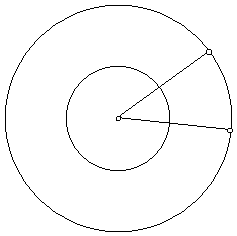
idea of 1-1 correspondence created problems in geometry. Consider two concentric circles with radii 1
and 2 inches repectively. One
circumference is double the other. But
on the other hand, draw radii from the center through any point on the smaller
out to the larger, or from any point on the larger through the smaller to the
center. You see easily a 1-1
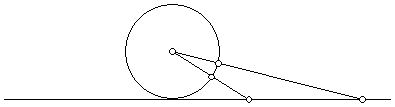
correspondence between points on the two circles. You can also show a 1-1 correspondence between points on the entire
line and the semicircle. However, you
have to leave out the endpoints of the semicircle, because otherwise it is too
big to be put in correspondence with the (infinite) line.
PROBLEMS:
22. Show how to put the points of a one
inch line in 1-1 correspondence with points on a two inch line.
23.
Show that: Between every two
rational numbers is an irrational.
Between every two irrationals is a rational. But there are many more irrationals: in a sense we will show
later.
C. ZERO AND THE
INFINITE. SELF-SIMILARITY INFINITE
The
next mathematical jump really involves the “invention” and use of the 0, sunya
or cipher. The mathematics of the
infinite in this time period is parallel to the attempt to grapple with the infinite in the domain of the
mystical and religious philosophy, the great speculative debates between the
Hindu and Buddhist worlds in north India, and creative minds in China, Tibet
and south Asia. And with the infinitely
complex visions of the Sufi masters in the middle east. And the continued explorations of the
Infinite, Ain Soph, of the Kabbalists. And the Scholastics grappling with the infinite mind of God.
READ:
Fa
Tsang: “The Hall of Mirrors” and the
excerpt of “On the Golden Lion”
Krishnamurthi: “Advaita and Mathematics”
St.
Augustine. Excerpts from “The Vision of
God”
D.
INFINITE SEQUENCES AND SERIES
From
there we move to the 17th century:
three great and connected ideas.
The calculus of infinitesimal tangent slope, the calculus of summing
more and more smaller and smaller parts, and the notion of the series.
In
the “infinite” sequences and series of Wallis, Euler etc. a developing notion
of a limit. Infinite series which converge to pi. We have to explain these terms: converge,
infinite series, and limit.
1671:
Gregory: 1 – 1/3 + 1/5 – 1/7 +
- … = π/4
1736
Euler 1/12 + 1/22 + 1/32
+1/42 + … = π2/6
In
the calculus of Leibnitz we have a revival of the infinitesimal idea: a tiny
segment with no length, but able to form a ratio to other infinitesimal
segments such that dy/dt makes sense.
Newton
and Leibnitz both formalize the insights of Archimedes, 2000 years earlier,
that you can take more and more of smaller pieces of a region to find its
area. And with this we can approach the
questions of motion left by Zeno. If a
function v(t) represents the velocity of a particle in terms of time t, how far
has the particle traveled from time a to b?
The answer can be represented as the area of a region in the plane
bounded by the graph of the function and the axis.
[Here
we need to visit some remarkable properties of sequences and series. We also went to look at them as generated by
recursion and multiple copy machines.
And
the idea of a limit.
And:
does a line straighten or not.
PROBLEMS:
Explore
the convergence of these canonical series:
Geometric
series with ratio 1/2: 1/2 + 1/4 + 1/8
+ …
Harmonic
series: 1/2 + 1/3 + 1/4 + …