Click here for a pdf version of my research statement.


Next: The Main Example
Up: Research Statement
Previous: Introduction
Bessel Models for General Admissible Induce Representations
The calculation of the space of Whittaker models is one of the main links between Number Theory and Representation Theory. A well known example of its applications is the proof of the multiplicity one theorem for  using the uniqueness of local Whittaker models given by Jacquet and Langlands [J-L, 1970] for
  and independently by Shalika [S-1974] and Piateski-Shapiro [PS-1979] for
  .
.
One of the reasons why the space of Whittaker models is so useful in the study of
is that all the representations appearing in its cuspidal spectrum have a Whittaker model, something that's not always true for other groups. For example for  ??? have shown that some automorphic cuspidal representations do not have a Whittaker model. One way around this is to work instead with the space of Bessel Models, that is, linear functionals in the unipotent radical of the Siegel parabolic. Since
  is abelian all its irreducible representations are one-dimensional, and hence all cuspidal representations will have a Bessel Model. A lot a work has been done to study this space of Bessel Models. In the real case the more general results can be found in [W-86] where a multiplicity one result is proved for a class of parabolic subgroups, later characterized to be the very nice parabolic subgroups [W-recent]. Here multiplicity one means the following: Let
  be a very nice parabolic subgroup, with given Langlands decomposition. Let
 be a finite dimensional representation of
  , and let
  be a complex valued linear functional on
 . Let
. Let
 be the smooth representation induced from
 , and let
  be a generic [W86] character of
. Let
be a generic [W86] character of
. Let

be the space of Whittaker functionals of
. Then
 |
(1) |
During his visit to UCSD during the academic year 2007-2008 Dipendra Prasad asked if a similar result was true in the case where
is an admissible, smooth, Frechet, moderate growth representation of
. In this case the statement about dimensions in equation (1) has to be replaced by an  -intertwiner isomorphism between
 and
and
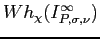 , where
In my joint work with Wallach [G-W] we use the theory of the transverse symbol of a vector valued distribution developed by Kolk and Varadajan [K-V] to prove this result in the case where
is compact. More formally we have the following result:
Let  be a connected simple Lie group with finite center and let
  be maximal compact subgroup. We assume that
  is Hermitian symmetric of tube type. Up to covering homomorphisms there is a one-to-one correspondence between the set of simple Jordan algebras and the set of Lie groups satisfying this conditions [G-W]. Let
be a parabolic subgroup, with given Langlands decomposition, such that
is abelian. Let
is Hermitian symmetric of tube type. Up to covering homomorphisms there is a one-to-one correspondence between the set of simple Jordan algebras and the set of Lie groups satisfying this conditions [G-W]. Let
be a parabolic subgroup, with given Langlands decomposition, such that
is abelian. Let
 be the representation induced by
 from
from  to
. Given
to
. Given
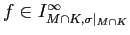 define

The map
 defines a
-equivariant linear isomorphism from
to
[W,vol1]. Let
defines a
-equivariant linear isomorphism from
to
[W,vol1]. Let  be an element in
  that conjugates
  to
to  and consider the integrals
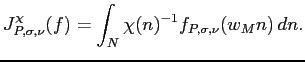
These integrals are called generalized Jacquet integrals and converge absolutely and uniformly on compacta for
 [W-86].
Let
[W-86].
Let
 and define
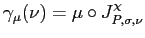 . Observe that if
then
. Observe that if
then
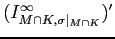
 defines a weakly holomorphic map into
 .
.
This theorem is essentially theorem 12 in [G-W].
In [G1] I look at the case when
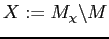
is not compact. In this case the above theorem as it is stated is false. The main reason for this is that in this case the orbits of the symmetric space
 under the action of a minimal parabolic are much more complicated that in the case where
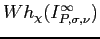
is compact [Matsuki]. However something can still be said about
under the action of a minimal parabolic are much more complicated that in the case where
is compact [Matsuki]. However something can still be said about
 . Assume
 [W,Vol1], and let
 be an irreducible, admissible infinite dimensional representation of
. Let
be an irreducible, admissible infinite dimensional representation of
. Let
 be the twisting of
  by
and let
by
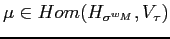
and let
 (Observe that
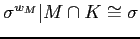 so this modification was unnecessary in the compact stabilizer case). As in the case were
is compact, define
and observe that if
then
defines a weakly holomorphic map into
so this modification was unnecessary in the compact stabilizer case). As in the case were
is compact, define
and observe that if
then
defines a weakly holomorphic map into
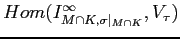 . Let
. Let
In [G1] I prove an equivalent formulation of this result.
In [J-S-Z] Jian, Sun and Zhu prove a uniqueness result for the space of Bessel Models of a large class of groups. However the space of Bessel models defined there is different than the one defined here, except for the special case of
 . In [J-S-Z] the parabolic subgroups considered keep a strong similitude with minimal parabolic subgroups in their structure. In the extreme cases this result reduces to the result of Sun and Zhu and independently Gourevitch and Aizenbud in one hand and the results on the uniqueness of Whittaker models for minimal parabolic subgroups in the other extreme.
Next: The Main Example
Up: Research Statement
Previous: Introduction
Raul Gomez
2010-09-22
|


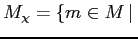


 to
to
 define

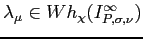 and the map
 defines an
  and
and


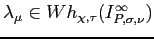 and the map
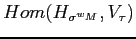 and
and
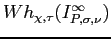 .
.
