Click here for a pdf version of my research statement.


Next: Further Research
Up: Research Statement
Previous: Bessel Models for General
The Main Example
Let  be a reductive group and le
 be a subgroup such that
 is a spherical variety, i.e., the Borel subgroup of
has an open orbit in
is a spherical variety, i.e., the Borel subgroup of
has an open orbit in  . In [S-V] Sakellaridis and Venkatesh give a conjecture describing the support of the Plancherel measure of
, and a Plancherel formula reducing this conjecture to the discrete spectrum (using a method of Bernstein). This conjecture generalizes the results of Harish-Chandra on
. In [S-V] Sakellaridis and Venkatesh give a conjecture describing the support of the Plancherel measure of
, and a Plancherel formula reducing this conjecture to the discrete spectrum (using a method of Bernstein). This conjecture generalizes the results of Harish-Chandra on  and of Delorme, Schlichtkrull and Van Der Ban for
  where
is a symmetric space (
where
is a symmetric space (
 is a symmetric space if there exists an involution
  of
such that
of
such that
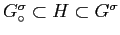 where
where
 is the set of fixed points of
and
is the set of fixed points of
and
 is its connected component). The description of the support of the Plancherel measure of
in [S-V] is given in terms of the ``dual group'' associated to the variety
by Gaisgory and Nadler [G-N]. This dual group construction formalizes an observation of Jacquet and many others [Ref?] and sets the basis for a ``relative'' Langlands program [Ref some paper of Sakellaridis talking about this].
is its connected component). The description of the support of the Plancherel measure of
in [S-V] is given in terms of the ``dual group'' associated to the variety
by Gaisgory and Nadler [G-N]. This dual group construction formalizes an observation of Jacquet and many others [Ref?] and sets the basis for a ``relative'' Langlands program [Ref some paper of Sakellaridis talking about this].
With this point of view the results of howe [H] describing the Plancherel measure of
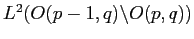 in terms of
 , and of Ørsted and Zhang [OZ 1,2] describing the Plancherel measure of
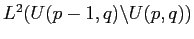 in terms of
  can be considered as Archimedian examples of Venkatesh and Sakellaridis result. Observe that in Howe's example
is not an algebraic group, however work has been done to include metaplectic groups into the Langlands Program [Adams, Mc].
can be considered as Archimedian examples of Venkatesh and Sakellaridis result. Observe that in Howe's example
is not an algebraic group, however work has been done to include metaplectic groups into the Langlands Program [Adams, Mc].
The goal at the beginning of my thesis was to generate examples similar to Howe's result, but that lie outside of the theory being develped by [S-V]. This is done in the following way: Let  be the Siegel parabolic of
 , with given Langlands decomposition, and let
 ,
,  , be the character of
  given by
where
and  is some fixed unitary character of
 . Let
. Let
Observe that
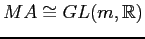 in a natural way, and in the notation of section 2
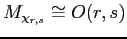 . In [G-Par] I give the follwoing decomposition of
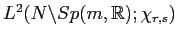
where  is the Plancherel measure of
  ,
,  is the Plancherel measure of
, and
is the Plancherel measure of
, and
 is some multiplicity space yet to be determined.
Also in [G-Par] I have the following proposition that generalizes and simplifies the work of Wolf and Howe [Wolf,Howe,...]
Proposition 4
For
-almost all tempered unitary representations  of
of
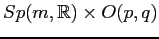
Now consider the dual pair
 ,
,  , and assume that
 . The last condition states that we are in the stable range. Howe showed that in the stable range the Oscillator representation
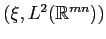 of
of
 decomposes in the following way when restricted to
where
is the Plancherel measure and
 is a representation of
  called the
  -lift of
. A lot of work has been done to describe the explicit
-correspondence and in the stable range case this correspoindence can be described using the work of Jian-Shu Li [JL] among others. Using this results an the explicit formulas for the action of
-lift of
. A lot of work has been done to describe the explicit
-correspondence and in the stable range case this correspoindence can be described using the work of Jian-Shu Li [JL] among others. Using this results an the explicit formulas for the action of
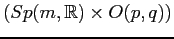 on
on
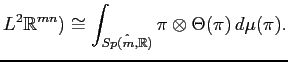
 given in [Rao, Admas,Roberts] I obtain the following description of
 in [G-Ex]
Observe that when  we regain Howe's result [H]. Also observe that in this case the decomposition given in equation (2) is contained in Wallach's work on the Plancherel-Whittaker measure for minimal parabolic subgroups. In this case Wallach result says that
 . It's therefore natural to state the following conjecture
Conjecture 6
With notation as above
For all  and all
  tempered and irreducible.
An important step in the direction of proving the conjecture is the calculation of the space
 where
is an induced representation which is done in [G-W] when
is compact, i.e.,
where
is an induced representation which is done in [G-W] when
is compact, i.e.,  or
or  , and in [G-1] in all the other cases. Using the results in [G-W] and following the ideas given in chapter 15 of [W,vol2] I have been able to calculate the Bessel-Plancherel measure of
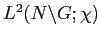 in the case where
  is compact. The calculations and the explicit Plancherel measure and intertwiners can be found in [G-2] and prove the conjecture in the compact stabilizer case. The full conjecture should be proved in a similar way, but first some complications of functional analysis nature should be solved. I will talk a little bit more about this difficulties in the next section.
Next: Further Research
Up: Research Statement
Previous: Bessel Models for General
Raul Gomez
2010-09-22
|


![$\displaystyle \chi_{r,s}\left(\left[\begin{array}{cc} 1 & X \\ & 1 \end{array}\right]\right) = \chi(\operatorname{tr} I_{r,s}X)
$](img81.png)
![$\displaystyle I_{r,s}=\left[\begin{array}{cc} I_r & \\ & -I_s \end{array}\right]
$](img82.png)

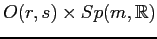 -module with

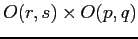 -module with

