Click here for a pdf version of my research statement.


Next: About this document ...
Up: Research Statement
Previous: The Main Example
Further Research
One of my immediate goals is to find a proof for the conjecture stated in last section. One of the main obstacles is to find an appropriate definition for the Schuartz space for
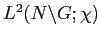 where
where  is an arbitrary character, but I expect that following the ideas given in [Delorme-Schwartz] and the track on Vol 15 of [W-vol2] I will be able to prove a Bessel-Plancherel theorem for this space which will prove the conjecture in the general case. Besides this project there are some other directions on which the results can be improved as I'll describe here.
In [W-recent] there is a classification of nice and very nice parabolic subgroups. In [G-W] we restricted our attention to the abelian unipotent case to simplify the exposition given in [W-86], and because in that paper a nice description of all the pertinent groups was given. It would be interesting to check if the calculations of
 can be applied to all very nice parabolic subgroups.
Another interesting problems is the calculation of
 for
not a character but a general irreducible unitary representation of
for
not a character but a general irreducible unitary representation of  . A good example is when
  is the Heisenberg parabolic, and
 is the irreducible representation associated with the central character
. Some work and explicit calculations have been given in [Narita] and it's tempting to try to use our approach to this problem.
is the irreducible representation associated with the central character
. Some work and explicit calculations have been given in [Narita] and it's tempting to try to use our approach to this problem.
The results given here should have equivalents in the p-adic and automorphic settings. In this case some arguments (like the holomorphic continuation of the Jacquet integrals given in [G-W]) should be adapted. But the statements should be very similar.
Another natural extension of this result is to look at other reductive pairs, not only to other dual pairs in the oscillator representation, but also to minimal representations of some exceptional groups, for example the representations described in [Gan-Savin].
In section 3 a description of the space
 is given in terms of representations of
 with the help of the
  -correspondence for the dual pair
 . As mentioned in the above paragraph other examples of this kind of correspondences may be found by looking at other dual pairs. It's a long term goal of mine to try to understand this correspondences in an intrinsic way, without having to resort to the theory of dual pairs, in a similar fashion to the result of Sakellaridis and Venkatesh [S-V] for spherical varieties.
Next: About this document ...
Up: Research Statement
Previous: The Main Example
Raul Gomez
2010-09-22
|


