
In this section I discuss what my classroom looks like and why.
Guided Exploration
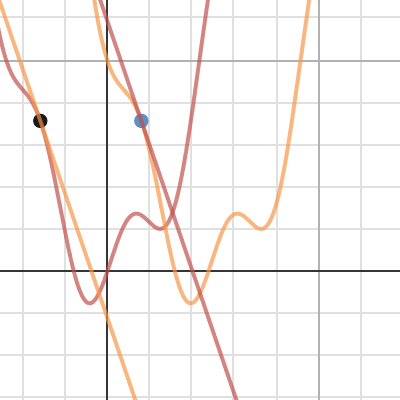
These demonstrations are a way for students to explore basic ideas in calculus. Sliders allow students to consider multiple examples, helping them bridge the gap between considering concrete functions like f(x+3) to the more abstract family of functions f(x+c). Students seem to find visuals appealing, and actively try to understand these pictures. In contrast, my students seem to accept formulas as facts, and don't have much curiousity about them. Curiousity and engagement help students to learn better.
In the demonstration below, students see that f(x+c) has the same derivative at x+c as f(x) has at x. This is one in a series that considers basic graph operations and what they do to the derivative.
Lecturing
Lecturing is important to my classroom as a way to present content in an organized way. Advantages of lecturing include having good control for how material gets presented, the ability to plan what boardwork will look like.
Without enough context, extensive use of activities can make a class feel disjointed and choppy. Through lecturing, students get a coherent picture, which with planning can have good flow from topic to topic. Lecturing done right includes insights into concepts and intuition in problem-solving that students often don't reach on their own and may be absent from the textbook.
In order to make lecturing live up to these standards, I try to plan carefully (as explained in the Planning section) and to monitor the reaction of the class so that I can adjust as necessary. If students look bored and sleepy, I'll ask a basic question, in order to determine if students are bored because they already know the material. If they seem to know it, I will pare down my explanantions and examples and move along. If they don't know the material, but are lost or sleepy (class was at 8 am after all), then the pairwise discussion helps to refocus them, and gives me a chance to back-track if students are badly confused.
I encourage student questions in class, even when it is an interruption. I rephrase the student's questions in the form `So you are asking X?' so that other students can follow the question and answer. I try very hard to control my face and not express annoyance in class, even for silly questions. I try hard to be welcoming of questions because a student interrupting me five minutes after we talked about something to ask a question is stuck back there. When I answer the same question five times that day, it is a sign that students are lost and confused or unfocused. Student questions are very valuable feedback. (In the rare occasion that a student is an egregious interrupter with lots of questions that are off-task, I talk with the student outside of class and ask them to reign it in. If not, I start using delay tactics on the badly off-topic questions - "You should think about that. Ask me again after class.")
Questioning
During class, I use questions to help keep the class engaged and together. I present a question. They need to think or write for a minute, and then they can discuss with neighbors and vote on or offer an answer. Many of my questions and inspiration for questions come from the Good Questions Project http://www.math.cornell.edu/~GoodQuestions/. The examples below come from there. I use these questions for two purposes:
- Quick checks/relating material to real life. These are easy to answer if you know what's going on. I use these often before/after introducing new concepts. This allows students to catch up and helps to get everyone on the same page before we continue.
Example: before introducing concavity ask students to describe the graph of height of water if you pour into a conical cup at a constant rate. This sets the stage for a discussion about the rate of change of a function increasing or decreasing.
- Addressing misconceptions. Multiple choice questions allow for a quick diagnosis of misconceptions.
There are many misconceptions that students face in calculus. In my opinion, the fastest way to inspire the cognitive dissonance to register that one's understanding needs to be re-evaluated is having half of the class say one thing and the other half say another.
Example: The line y=x has (a) no tangent line at (0, 0), (b) tangent line y=x at (0,0), (c) infinitely many tangent lines at (0,0).
When trying to address misconceptions, I have found that it usually takes awhile for the new idea to settle in so I usually re-assess their understanding a few days later.
Relating Abstract Material to Concrete Experiences
The document below demonstrates relating abstract concepts to the experiences of students. In calculus students often struggle with the abstraction of theorems and definitions - they aren't sure why theorems are true or what they mean. Students have a lot of physical intuition for change that can be harnessed to help them make meaning. From this intutition, many students can get a `feel' for the abstract math that helps them learn it.
The document below accompanies the students' first exposure to the Fundamental Theorem of Calculus, but focuses on the hardest part for most students, the accumulation function, ie the antiderivative of a continuous function. I set this assignment to relate it to a VERY familiar concept - calculating distance travelled from a speed function.
