Meeting time: TTh 11:40 am - 12:55 pm
Location: Malott Hall 207
Instructor: Daniel Jerison
Office hours: M 2-4 pm, Malott Hall 581
Email: jerison at math.cornell.edu
TA: Ahmad Rafiqi
Office hours: T 3-4 pm, W 2:30-4:30 pm, Malott Hall 218
Email: ar776 at cornell.edu
This course is an introduction to complex analysis with emphasis on applications. Topics include analytic and harmonic functions, contour integration, Taylor and Laurent series, residues, conformal mapping, and the Fourier and Laplace transforms.
Fundamentals of Complex Analysis by Saff and Snider, 3rd edition. You can buy it for less than $20 at this link.
25%: Weekly homework
20%: Prelim 1
20%: Prelim 2
35%: Final exam
The Mathematics Department's (voluntary) guideline for the median grade in courses at this level is B+. This will probably be close to the median for this course.
Prelim 1 is on Thursday, September 24, in class. It covers all of Chapters 1-3 except Sections 1.6, 2.7, 3.4, and 3.6. Practice exam. Solutions to practice exam. Actual exam and solutions.
Prelim 2 is on Thursday, November 5, in class. It covers all of Chapters 4-5 except Sections 4.4a, 4.7, 5.4, and 5.8, and also covers Sections 6.1-6.4. Practice exam. Solutions to practice exam. Actual exam and solutions.
The Final exam is on Friday, December 11, from 2-4:30 PM. Location is Malott Hall 253. Barring the 24 hour rule, you must take the exam at this time. Practice exam. Solutions to practice exam. Actual exam and solutions.
Topics covered on final exam:
Ch. 1-3: Geometry of complex numbers; complex exponential function; complex differentiation; analytic functions; linearization; Cauchy-Riemann equations; harmonic functions; complex trig functions; complex logarithm; multi-valued functions and branch cuts; complex powers; Dirichlet problem on strips and wedges.
Ch. 4-6: Contours and parametrization; contour integrals; path independence and existence of antiderivative; Cauchy's Theorem; Cauchy integral formula (including generalized version); Cauchy estimates; Liouville's Theorem; mean value property for analytic and harmonic functions; maximum modulus principle; maximum and minimum principles for harmonic functions; power series and radius of convergence; representation of analytic functions by Taylor series; Laurent series (existence, convergence on annuli, computation); classification of zeros and singularities; Residue Theorem; semicircular contours and Jordan's Lemma; indented contours; integrating along branch cuts; Argument Principle; Rouche's Theorem.
Ch. 8: Fourier series; Fourier transform; Laplace transform; inversion formulas; solving differential equations using the three transforms.
Topics not covered on final exam:
Stereographic projection; epsilon-delta definitions of limits and derivatives; connection between Cauchy's Theorem and Green's Theorem; Poisson integral formula; uniform convergence of series; point at infinity; invariance of Laplace's equation under conformal transformation.You are encouraged to work with each other on the weekly homework. Everything you write should be in your own individual words; direct copying is forbidden! You are not allowed to get help from any other person or source on an exam, including the textbook, unless that exam's instructions specifically permit it.
To be continued and subject to change.
Week 1 (8/25, 8/27): Sections 1.1-1.5. HW 1: Exercises 1.1.8, 1.1.14, 1.2.4, 1.2.10, 1.3.6, 1.3.8, 1.3.12, 1.4.2, 1.4.10, 1.4.18, 1.5.4, 1.5.10. Solutions. Due Thursday 9/3 in class.
Week 2 (9/1, 9/3): Sections 1.7-2.3. (Section 1.6 was skipped.) HW 2: here. Solutions. Due Thursday 9/10 in class.
Week 3 (9/8, 9/10): Sections 2.4-2.6. HW 3: Exercises 2.4.1, 2.4.2, 2.4.8, 2.4.10, 2.5.1, 2.5.2, 2.5.3(abf), 2.5.5, 2.5.8, 2.5.14, 2.5.20, 2.6.1. Hint for 2.5.20 and extra credit problem. Solutions. Due Thursday 9/17 in class.
Week 4 (9/15, 9/17): Sections 3.1-3.3, 3.5. No homework this week.
Week 5 (9/22, 9/24): Review and Prelim 1.
Week 6 (9/29, 10/1): Sections 4.1-4.3, start of 4.4b. (Section 4.4a was skipped.) Supplement on Cauchy's Theorem. HW 4: here. Solutions. Due Thursday 10/8 in class.
Week 7 (10/6, 10/8): Sections 4.4b-4.6. HW 5: Exercises 4.4.12, 4.4.16, 4.5.1, 4.5.2, 4.5.3(bdf), 4.5.4, 4.5.6, 4.6.1, 4.6.4, 4.6.9. Solutions. Due Thursday 10/15 in class.
Week 8 (10/15): Sections 5.1-5.3. HW 6: Exercises 5.1.20, 5.1.21, 5.2.1(aef), 5.2.2(aef), 5.2.4, 5.2.5(abc), 5.2.14, 5.3.2, 5.3.3(ade), 5.3.4, 5.3.8. Hint for 5.1.20. Solutions. Due Thursday 10/22 in class.
Week 9 (10/20, 10/22): Sections 5.5-5.7. HW 7: here. Solutions. Due Thursday 10/29 in class.
Week 10 (10/27, 10.29): Sections 6.1-6.4. No homework this week.
Week 11 (11/3, 11/5): Review and Prelim 2.
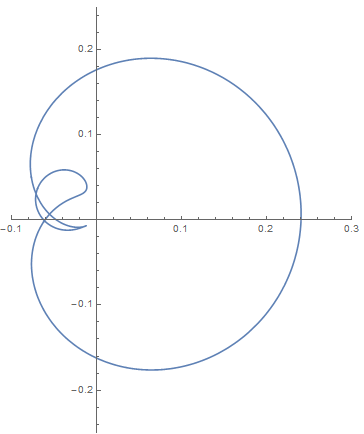
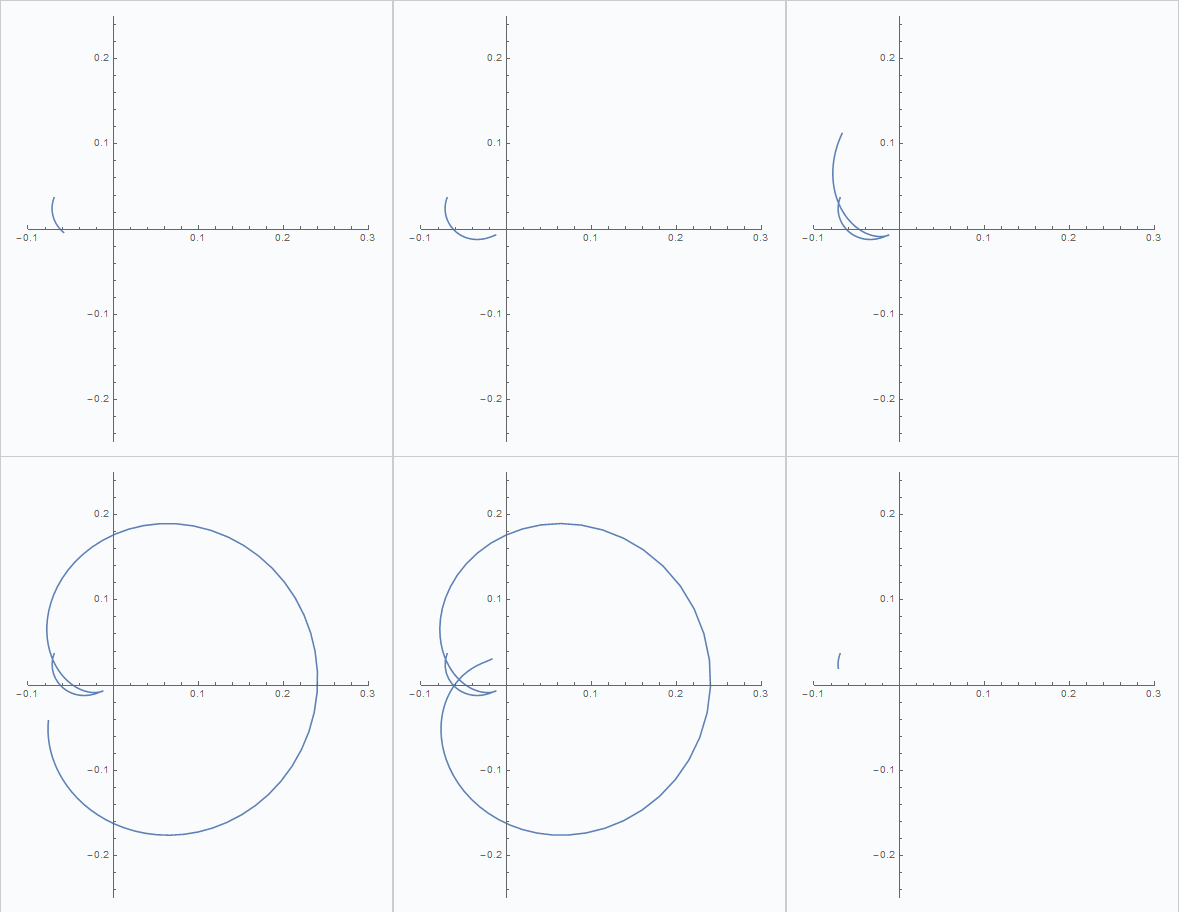
Week 12 (11/10, 11/12): Sections 6.5-6.7. HW 8: Exercises 6.5.2, 6.5.4, 6.5.5, 6.6.1, 6.6.2, 6.6.9, 6.7.2, 6.7.3, 6.7.6, 6.7.10, 6.7.21. Hints: For 6.5.4 and 6.5.5, write the integrand as the real part of a complex function. Also note that it is even. For 6.7.10, see Example 3 in the textbook. Solutions. Due Thursday 11/19 in class. Also, here are a still image and an animated trace of the image under the function f(z) = (z-i)^2 / [(z+2)^3*(z-5)] of the counterclockwise circle of radius 4 about the origin. Images were created in Mathematica by Christopher Sund.
Week 13 (11/17, 11/19): Section 8.1, start of 8.2. HW 9: Exercises 8.1.1, 8.1.6, 8.1.7a, 8.1.10, 8.1.11, 8.2.5. Solutions. Due Tuesday 11/24 in class.
Week 14 (11/24): Section 8.2, start of 8.3. HW 10: here. Note: For 8.2.1(d) and 8.2.3(a), when finding the Fourier transform you may use principal value integrals. Solutions. Due Thursday 12/3 in class.
Week 15 (12/1, 12/3): Finish Section 8.3. Sections 3.4, 4.7, 7.1. HW 11 (OPTIONAL, NOT TO BE TURNED IN): Exercises 8.3.1(ade), 8.3.3(abc), 8.3.4, 8.3.5(ac), 8.3.6(a), 3.4.2, 3.4.3, 4.7.1, 4.7.4, 4.7.11. Hints: For 8.3.3, use the table on page 479 of the textbook. For 8.3.6(a), in the inversion formula choose a=0 and make the change of variables s=iz so that you can use Jordan's Lemma. Solutions.